Why Guyana Is South America's Best-Kept Secret

Updated: Aug 28
Some places impress you. Others stay with you long after you've left. Guyana did both.
The Last Place That Still Felt Wild
It was a random Wednesday afternoon when I stumbled across an unexpectedly cheap flight to Guyana on Skyscanner.
If you had asked me a month earlier what was there, my answer would have been embarrassingly short: rainforest, maybe waterfalls. Honestly… that was about it.

I didn’t know anyone who had been. My Instagram feed wasn’t full of it, and there weren’t countless TikToks telling me where to eat or which viewpoints were “must-sees.” It felt like one of the few places left that hadn’t been over-explained.
Maybe that was exactly what made me book it.
Somewhere along the way, travel had started to feel predictable. Before I had even boarded the plane, I already knew what the famous viewpoints looked like, which cafés were trendy, and which streets would inevitably end up on my camera roll. I wasn’t discovering places anymore—I was recognizing them.
Guyana offered me the chance to be surprised.
Looking back, I wasn’t searching for another stamp in my passport. I was searching for the feeling that had made me fall in love with travel in the first place.
I just didn’t know it yet.
Arriving Without a Plan
When I landed in Georgetown, the city felt refreshingly unpolished—a place where daily life unfolded without trying to impress visitors.
It also became clear rather quickly that I probably should have done more research.

Guyana was one of the most challenging places I have traveled to alone—not because I felt unsafe, but because its tourism infrastructure is still limited. Many lodges and tours need to be arranged in advance, some don’t accept solo travelers, and traveling beyond Georgetown requires more planning than I had anticipated.
I arrived with little more than an Airbnb booked for my first night and the hope that everything else would fall into place.
Against all odds, it did.
After many WhatsApp messages and last-minute arrangements, I had a plan: visit one of the world’s most spectacular waterfalls, followed by a journey deep into Guyana’s remote interior.
Less than 24 hours after arriving with no real plan, I was preparing to see the country from the air.
Flying to Kaieteur Falls
When I woke up the following morning, I immediately looked outside and felt relieved to see blue skies. I had taken a gamble by visiting during the rainy season, and with a flight to Kaieteur Falls scheduled that morning, the weather couldn’t have been more important.
With the forecast seemingly on my side, I made my way to the tiny airport. The small propeller plane waiting on the runway made the adventure suddenly feel very real.
After a quick check-in, I climbed aboard and settled beside the window. Georgetown gradually disappeared behind us, replaced by an endless sea of rainforest stretching in every direction.
For the next 45 minutes, there were no towns, roads, or obvious signs of civilization below, only dense jungle extending toward the horizon.
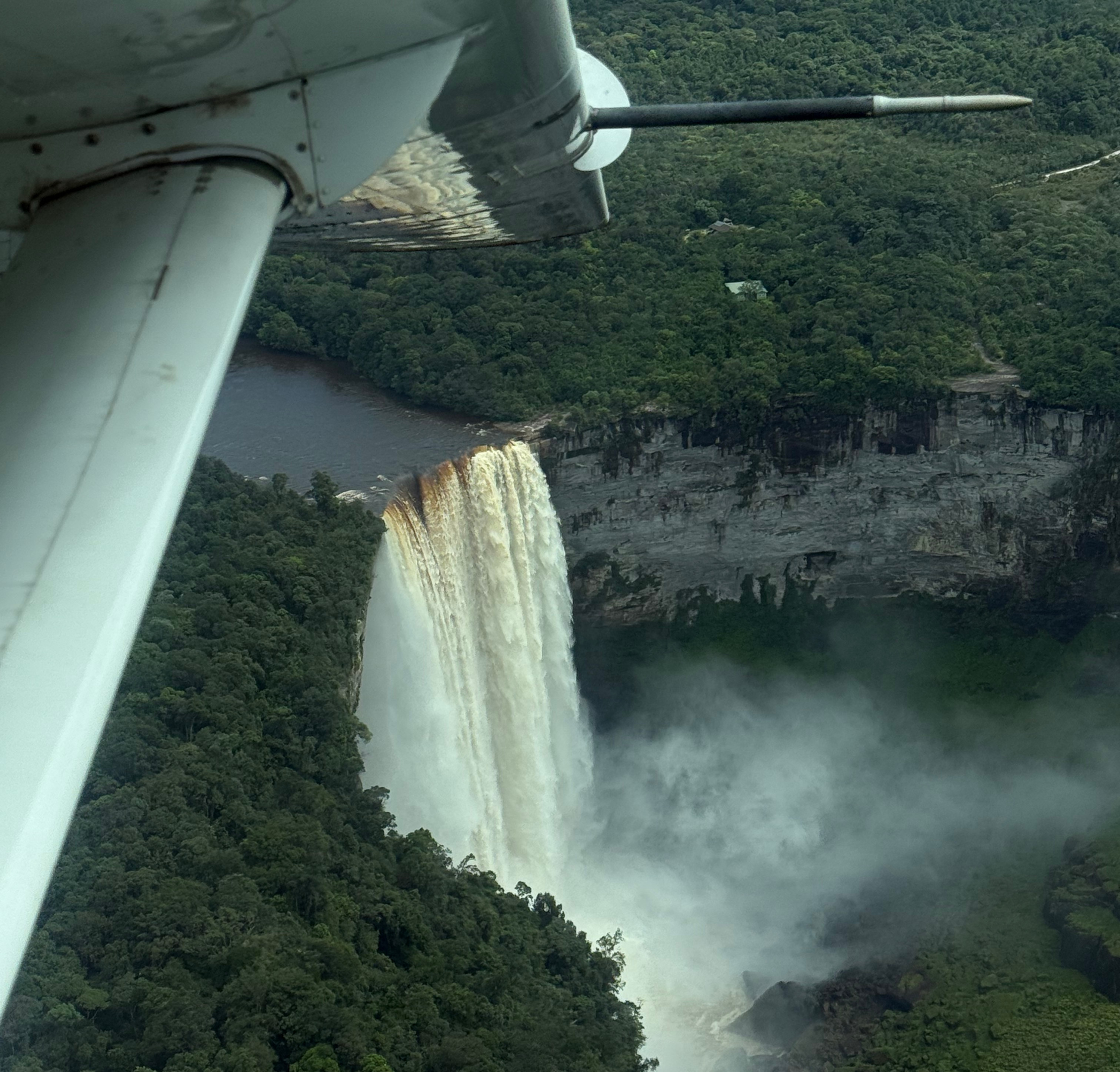
Then, suddenly, the trees gave way.
Rising from the jungle was a massive sandstone cliff, with an unimaginable volume of water plunging over its edge. The pilot circled the falls several times before landing, and I practically pressed my face against the window trying to take in every angle.
After landing, we followed a short trail through the forest toward the gorge. I heard the waterfall before I saw it. Its roar echoed through the trees before the view opened in front of me.
Then I stepped onto the lookout.
Seeing Kaieteur from the air was spectacular, but nothing compared to standing beside it.

Water crashed into the gorge with such force that mist rose continuously from below. Sunlight caught the spray and it created a rainbow across the valley.
For a moment, it felt like I was standing at the edge of the world.
Nothing had prepared me for its scale. It wasn’t simply beautiful; it was overwhelming—the kind of place that makes you feel incredibly small.
Kaieteur alone would have made the journey worthwhile. Somehow, though, my favorite part of the adventure was still ahead of me.
The Long Road to the Rupununi
Before sunrise the following morning, I loaded into a van for an 18-hour journey through the Amazon Basin toward the Rupununi, a remote savannah region in southern Guyana.
We left Georgetown while the city was still dark. As daylight began filtering through the trees, the pavement disappeared beneath us.
Towering trees crowded the roadside, their branches draped in thick vines and giant ferns. Rich red-dirt roads were carved with deep potholes and muddy ruts. We bounced, lurched, and slid through the jungle for hours. More than once, one of the vans became stuck in the mud and had to be pulled free before we could continue.
Yet none of it felt frustrating. The unpredictability of the road only made me more aware of how far we were traveling from everything familiar.

With every mile, the landscape began to change. Dense rainforest slowly opened into sprawling grasslands dotted with termite mounds and grazing cattle. The mountains and jungle faded behind us as the savannah stretched farther into the distance.
I kept my eyes fixed on the water-filled ditches outside my window, hoping to catch a glimpse of a caiman beneath the surface.
To my surprise, I spotted two.
By the time we reached the Rupununi, I realized the drive hadn’t simply been transportation. The mud, the jungle, and the changing landscape were all part of the experience.

In Guyana, the journey itself was becoming as memorable as every place it took me.
Thirty-Six Hours in the Rupununi
I had only about 36 hours to experience the Rupununi, but nearly every one of those hours held a new adventure.
I wandered the quiet streets of Lethem, the small town where I was staying, and crossed the border into neighboring Brazil for lunch. There was something surreal about slipping into another country for the afternoon and returning to Guyana in time for dinner.
But the moment I remember most began before sunrise the following morning.
Determined to see an anteater in the wild, I hired a local guide who picked me up on his motorcycle while the sky was still dark. Together, we rode across the savannah as the first light crept over the horizon, scanning the grasslands and termite mounds for movement.
The air was cool, the landscape seemed endless, and for a while, we saw nothing.
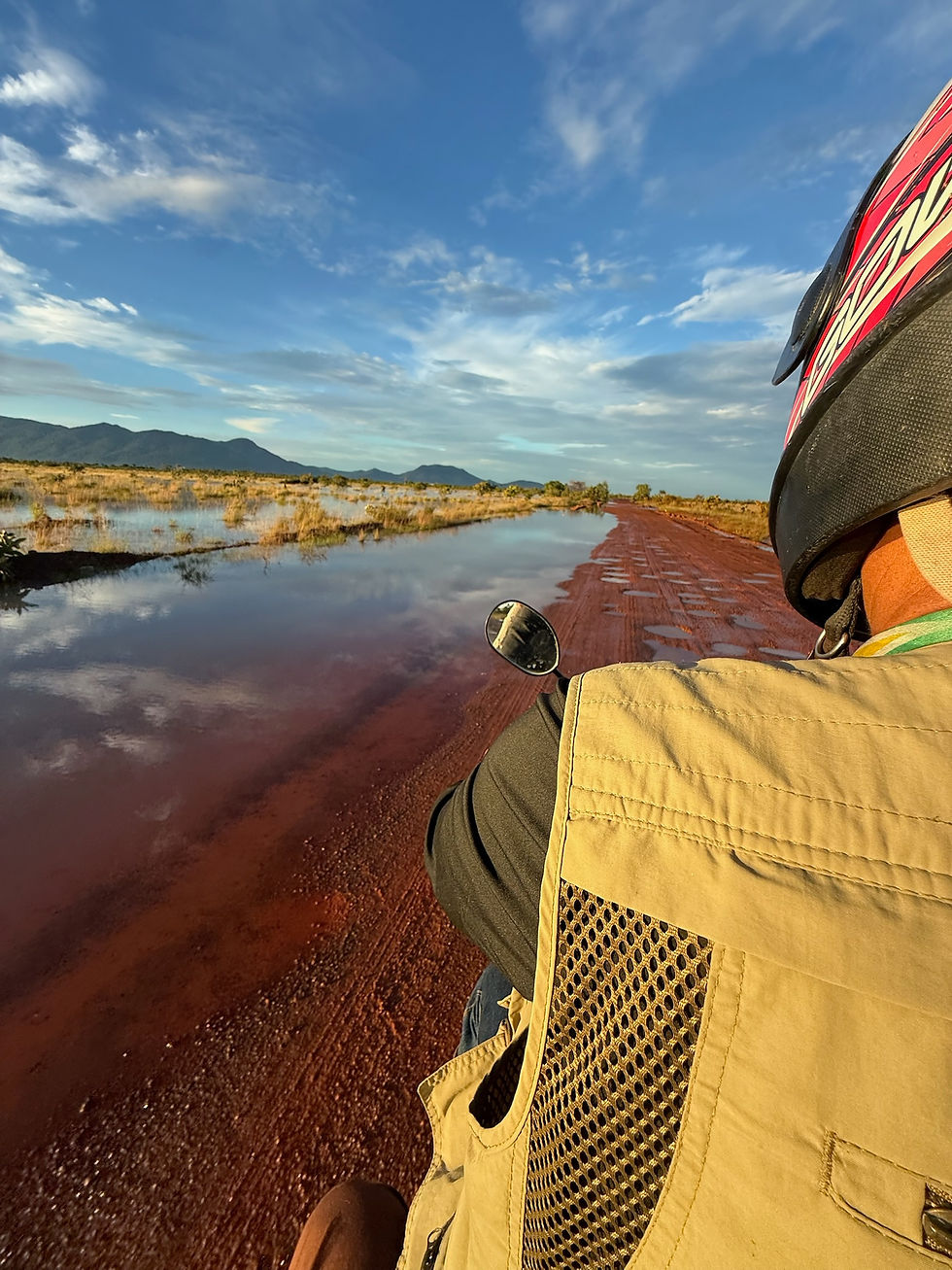
Then, there it was.
An anteater wandered slowly across the savannah, completely unaware that it had just given me one of the moments I had traveled halfway around the world hoping to find.
We watched quietly from a distance as it continued its morning undisturbed. There was no crowd, no viewing platform, and no line of safari vehicles competing for a better angle.
It was simply the savannah, the rising sun, and an animal moving through its natural world.
South America’s Best-Kept Secret
Soon, it was time to return to Georgetown. I spent my final day wandering through Stabroek Market, sampling Guyanese food, and admiring the city’s wooden colonial architecture before heading home.
As my flight lifted above the rainforest, I thought back to that random Wednesday afternoon when I had impulsively booked a ticket to a country I knew almost nothing about.
Guyana had reminded me why I started traveling in the first place.

Not to check destinations off a list or recreate photographs I had already seen online, but to experience places that still have the power to surprise me.
Guyana isn’t the easiest destination to visit. It requires planning, patience, and a willingness to embrace the unexpected. Yet that may be exactly why it has remained so special.
Here, waterfalls rise from seemingly endless rainforest, anteaters wander across open savannah, and an 18-hour drive through the jungle can become one of the most memorable parts of the trip.
That is why Guyana feels like South America’s best-kept secret—a place still wild enough to surprise you, remote enough to feel undiscovered, and unforgettable enough to stay with you long after you’ve left.
Threads & Terrain was created for travelers searching for that same sense of discovery. Explore a different way to see the world.


Comments